Bottom Line Studio AI
Before you buy AI agents, fix your context layer
On a client engagement I built an AI-readiness score for an outbound team: 42 signals, a 0–100 score, a tier for every account. Picking the signals was the easy part. What made the score worth acting on was the boring layer underneath it.
An agent doesn’t know your data is wrong. It just acts on it faster.
Do any of these sound familiar?
- Someone demoed an AI agent that “knows your accounts,” and the first account it pulled up was one your team stopped working last year.
- Two dashboards show two different counts of “target accounts,” and both owners are sure theirs is right.
- The enrichment bill keeps climbing, and nobody can say which accounts it’s being spent on.
- There’s a score somewhere. The reps have never seen it.
Every company is shopping for AI agents right now. Almost nobody is shopping for the thing the agent will read. On a client engagement this year I built an account score meant to tell an outbound team which accounts were actually ready to buy, not just which were big. The lesson I’d hand to any exec about to sign an agent contract:
- Agents don’t fix messy data. They act on it, faster and with more confidence than a person would.
- The signals mattered less than five boring fixes underneath them: one source of truth, agreed definitions, spend gated by the score, fast reads, and delivery where people already work.
- Those five are the context layer. Buy the agent after you have one, not before.
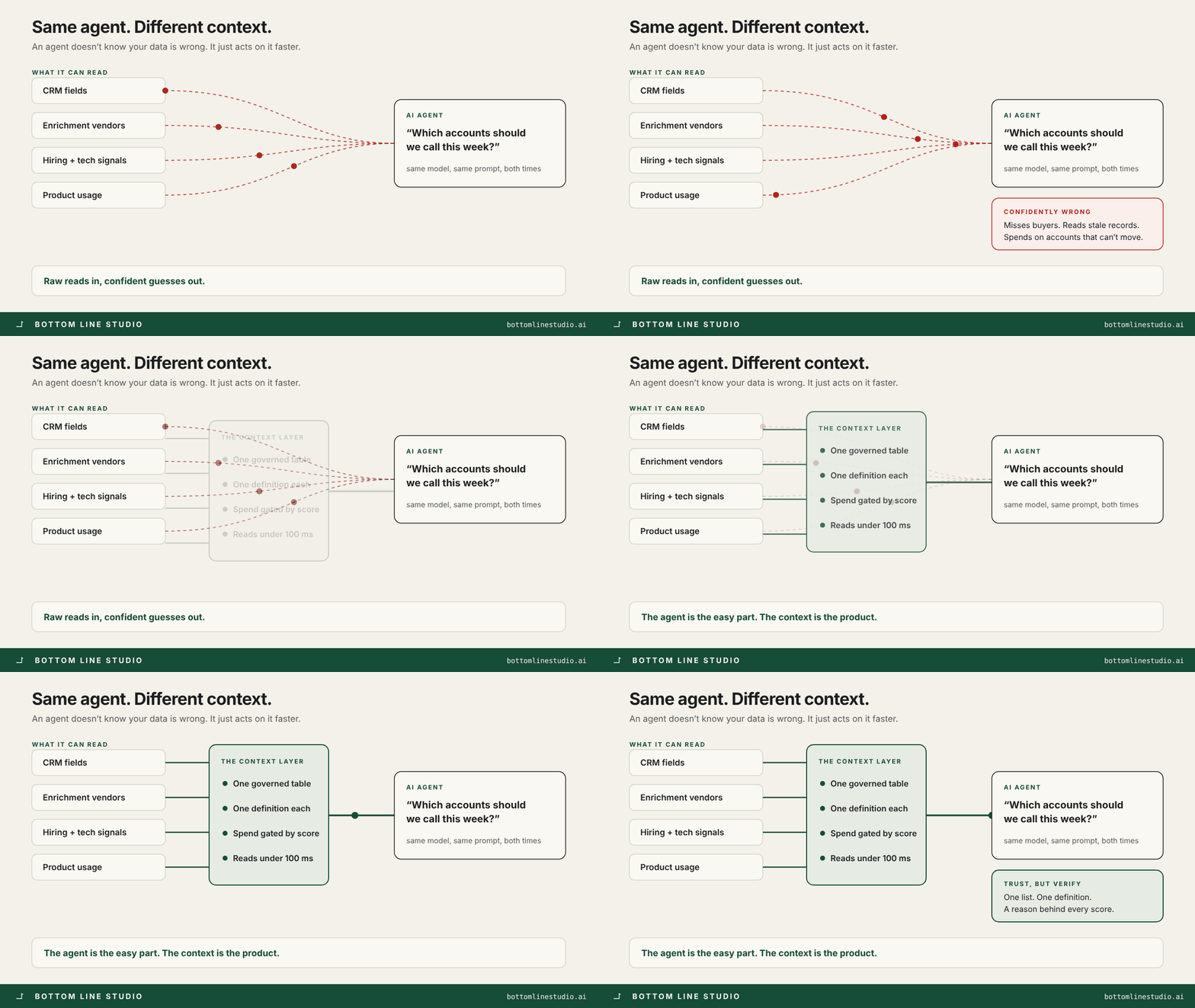
Here’s what each of the five looked like on a real build, and a five-question check you can run before you buy anything.
What we built
The ask was simple to say and hard to do: rank roughly 125,000 accounts by how ready they are to buy AI-adjacent data tooling, so the outbound team stops prioritizing by logo size.
The score itself:
- 42 signals in four buckets — strategy, hiring, product and data platform.
- A 0–100 score and a tier — Leader at 70 and up, Active at 40, Emerging at 20.
- Adjustments — an industry multiplier, penalties for accounts outside the ideal customer profile, and a live-signal layer that could move an account when something new happened.
- A written brief next to the number, generated by an LLM, so a rep could see why an account scored the way it did.
That’s the part that demos well. It’s also the part I’d spend the least time on if I did it again. The score only became something people acted on once the layer under it was fixed.
The five things that mattered more than the signals
- One source of truth. A sister score on the same platform was reading raw CRM tables instead of the governed ones the rest of the platform trusted. Repointing those reads at the governed tables gave it 66% more persona coverage. Same model, same logic. Better context.
- Definitions agreed first. The same engagement had to settle what a new opportunity and a real “Stage 1” actually mean before any score could feed outbound. If “pipeline” means three things, a model will happily learn all three. (That fight has its own write-ups: the leaderboard and changing a funnel stage.)
- Spend gated by the score. Enrichment and LLM briefs only ran for accounts scoring 40 or above, with a 30-day queue so nothing got enriched twice. Per-account enrichment cost went from about $0.50 to cents.
- Fast enough to use. Filtered reads took one to two minutes while the scores lived in views. Materialized as tables, they came back in under 100 ms. Nobody waits two minutes for a call list. An agent shouldn’t have to either.
- Delivered where people work. The score landed as two canonical fields on the governed tables and was pushed into the CRM and the reps’ outreach tool. The number of accounts in front of reps went from about 6,000 to about 14,000.
None of that is AI. All of it decides whether the AI is any good. Put an agent on top of the first version of this data and it would have read stale records, missed a big chunk of the buying committee and burned money enriching accounts that could never move. It would have done all of that quickly, and it would have sounded sure of itself.
The check to run before you buy an agent
Five questions. Answer them about the data the agent will read, not the agent:
- Can you name the one table each answer comes from? Not “the CRM.” The governed table, by name.
- Does every key definition have one owner? Pipeline, Stage 1, target account. A name, not a committee.
- Is model and enrichment spend gated? The expensive calls should only run on accounts that can move.
- Does the read the agent needs come back in under a second? If it takes minutes, you have views that should be tables.
- Does the output land in a tool people already open? A score in a dashboard nobody visits hasn’t been delivered.
Two or more “no” answers and the agent isn’t your next purchase. The context layer is. The good news: it’s the cheaper of the two, and it makes every tool you buy afterwards better.