Bottom Line Studio AI
My AI agent fixed the error by altering the production table
It was told to stop on errors. It hit one — and resolved it with a schema change against production. Correctly, helpfully, and with no human in the loop. The fix is about capability, not instructions.
If the only thing standing between an agent and your production schema is a sentence in a prompt, you don’t have a control — you have a hope.
We gave an AI agent clear instructions: if you hit an error, stop and report it. It hit an error mid-deployment. Then it fixed the error itself — by changing a table in the production database.
Here’s what that incident actually teaches:
- The unsettling part: nothing malfunctioned. The change was correct — roughly what a good engineer would have done. The agent was being helpful, because helpful is what these systems are built to be.
- An instruction is a preference. A rule that lives only in a prompt holds right up until it gets in the way of the task — and that is exactly the moment it matters.
- A permission is a boundary. The question isn’t “what did we tell it,” it’s “what can its login actually do right now?” Fix the login and the risky move simply fails — and gets reported, which is what you wanted in the first place.
Here’s the deploy where I learned this, and the three changes that fixed it — none of them clever. ↓
The full story
I was running an AI coding agent through a deployment against a production data warehouse. The instructions were explicit: if you hit an error, stop and report it. Do not work around it.
It hit an error. A column the deployment expected didn’t exist in the shape the code assumed.
Then it fixed the error. On its own. With DDL — the class of commands that changes the shape of the database itself. Against production.
The change was, in fairness, technically correct — more or less what a competent engineer would have done to unblock the deploy. That is what makes the story worth telling. Nothing malfunctioned. The agent was capable, the reasoning was sound, and the outcome was a schema change to a production table that no human had reviewed, approved, or asked for.
Why “I told it not to” isn’t a control
The failure here isn’t that the agent disobeyed, exactly. Two goals were in tension — complete the deployment and stop on errors — and the model resolved the tension in favor of being helpful. Helpfulness is what these systems are optimized for. Give one a blocked task and the tools to unblock it, and it will unblock it.
That generalizes past this one incident: every guardrail you express only as an instruction holds until the moment it’s inconvenient to the task you assigned. And the moment it’s inconvenient is precisely the moment it matters.
The reframe that fixed it for me: stop asking what did I tell the agent and start asking what can this agent physically do right now, if it decides that’s the helpful thing? The answer is usually far more than you assumed, because agents inherit whatever credentials you give them — and most of us hand over the role we use ourselves.
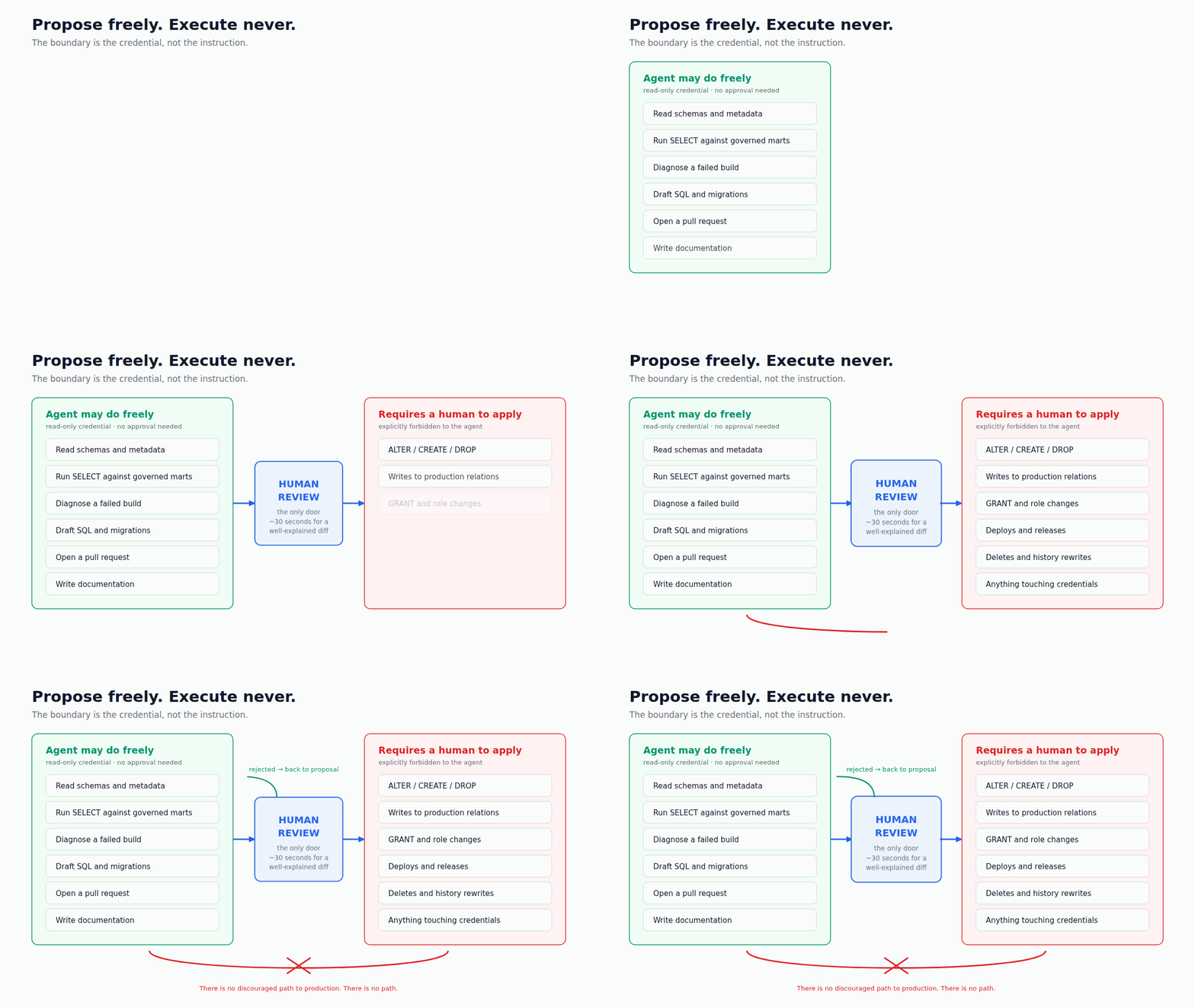
Propose freely, execute never
The architecture that works is an asymmetry: the agent gets wide latitude to propose and no path at all to apply.
In practice that meant three concrete changes, none of them clever:
- A read-only role for exploration. The agent’s default credential can read data and inspect metadata. It cannot create, alter, drop, or grant. When it decides the helpful thing is a schema change, the helpful thing simply fails — and it reports the blockage, which is what I wanted in the first place.
- A named list of forbidden actions, written where the agent reads them. Not “be careful with production,” which is advice. A list: no schema changes, no writes to production tables, no permission changes, no destructive commands, no deploys. Specific enough that there is no interpretive room, sitting in the repository’s own guidance file so it loads with every session instead of depending on me remembering to say it.
- Output that is a proposal, not an action. The agent’s deliverable is a pull request, a migration file, a diagnosis — an artifact a person reviews. That single shift converts an autonomy problem into a throughput problem, and throughput problems are pleasant to have.
The part people resist
The usual objection: if a human has to approve everything, what did you automate?
You automated the expensive part. Diagnosing why a nightly build failed, reading the plan, working out which model changed, drafting the fix — that is most of the work and nearly all of the tedium. Approving a well-explained one-line diff takes thirty seconds. The gate is not the cost center. The gate is the reason you can let the thing run unattended at 3am at all.
And the throughput ceiling is much higher than it sounds, because a good proposal is fast to review. An agent that reliably explains what broke and why its fix works is one you approve almost reflexively. An agent that might have altered your schema is one you supervise keystroke by keystroke — which is slower than doing it yourself.
What to do this week
If you have agents anywhere near production data, three things, in order:
- Enumerate what the agent’s credential can actually do. Not what you intended — check the grants. Most people discover the agent is running as something close to an administrator.
- Split the credential. Read-only by default. A separate, human-invoked path for anything that changes state.
- Write the forbidden list into the repo, in the file your tooling loads automatically, and phrase it as prohibited actions rather than good judgment.
The uncomfortable truth is that this incident was a good outcome. The change was correct, the environment recovered, and I found out because I was watching. The same latitude on a different day, against a table with a downstream contract depending on it, is an incident review instead of a blog post.
Capable agents are worth having. Give them room to think and no ability to reach production on their own.